Hip Drift: The Silent Leak That Kills Your Power
Strength Without Breaking Series "Drift"
Coach Gabe
5/19/20268 min read


Understanding Hip Drift
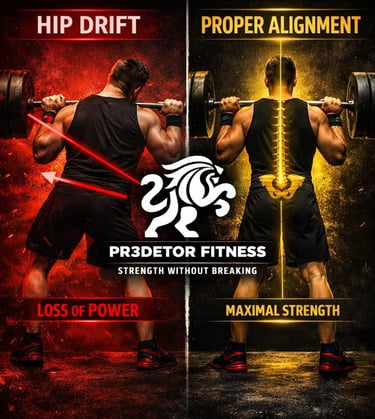
Hip drift, often referred to as a "silent leak" in athletic performance, represents a significant yet frequently overlooked concern in strength and power training. This phenomenon occurs when the hips shift out of their optimal position during exercise, leading to ineffective bracing techniques and compromised core stability. As a result, the ability to generate and sustain power diminishes, seriously impacting overall athletic performance.
The mechanics of hip drift can be subtle, making it a challenging issue to identify. Athletes may continue to move with apparent ease, unaware that their power output is being undermined. For instance, during squats or deadlifts, an athlete may unknowingly allow their hips to sag or shift laterally, disrupting the line of force and lessening the load effectively supported by their core. This not only undermines strength but also increases the risk of injury, as improper form may place undue strain on surrounding muscles and joints.
A relatable analogy can be drawn from the concept of a leaking tire. Just as a tire loses air gradually, leading to a decline in performance without immediate awareness, hip drift erodes an athlete's capacity to generate power over time. The inability to maintain proper hip alignment diminishes the effectiveness of powerful movements, thereby resulting in suboptimal training outcomes. Athletes who neglect to address hip drift may find themselves plateauing or even regressing in their performance, emphasizing the importance of early detection and intervention.
Incorporating assessments and targeted exercises that focus on maintaining optimal hip alignment can greatly aid in counteracting the effects of hip drift. By prioritizing core stability and bracing techniques, athletes can minimize the risks associated with this silent leak, enhancing their potential for improved strength and performance.
Biomechanics Breakdown
Understanding the biomechanics of hip drift is crucial for athletes and fitness enthusiasts alike. Hip drift refers to the misalignment that occurs between the pelvis and the rib cage during various movements, ultimately disturbing the body’s optimal posture. This misalignment is often a subtle yet significant contributor to inefficient movement patterns.
The core principle of biomechanics involves the relationship between different body segments and how forces are transmitted through the kinetic chain. Ideally, the alignment between the ribs and pelvis should be maintained to ensure proper force generation and transfer through movement. When hip drift occurs, the alignment is compromised, which can lead to muscle imbalances and compensatory strategies that leak strength away from the kinetic chain.
Maintaining proper posture and spinal alignment during movements is essential, as it helps distribute forces evenly across the body. When hip drift leads to a deviation in this alignment, it can cause certain muscle groups to overwork while others underperform, resulting in inefficient movement patterns. For example, an athlete may experience undue stress on their lower back or hips due to compensatory mechanics stemming from hip drift.
Moreover, the kinetic chain's integrity is vital for sustaining athletic performance and preventing injuries. The interdependence of muscle groups means that inefficiencies caused by hip drift can predispose an athlete to injuries over time. Understanding and correcting hip drift through targeted exercises and postural awareness is paramount to maintaining optimal movement mechanics.
Fix: Stack and Freeze
Combatting hip drift effectively requires understanding and implementing the 'stack and freeze' method. This technique focuses on realigning the ribs over the pelvic floor, thereby stabilizing the body and improving overall performance in various physical activities. Here, we will detail the steps to properly execute this technique, highlight common pitfalls, and offer practical tips for integrating it into your training regimen.
To begin with the stack and freeze method, stand straight with your feet shoulder-width apart. Engage your core by pulling your belly button towards your spine. Begin by positioning your ribs directly above your pelvic area; this alignment is crucial in preventing hip drift. Next, focus on your glutes and thighs, ensuring these muscles are slightly activated.
*Coach Tip- Exhale out violently this is to learn only guys. When the air is expelled your ribs naturally align with pelvic floor. Visualize fogging a mirror with your breath.
The first step is to visualize a stack of blocks, where each block represents a part of your body—your ribs, pelvis, and legs. Keep each block aligned as you move. As you maintain this alignment, take a deep breath in, allowing your diaphragm to expand fully without disturbing the stack. Once you have established your position, hold for a few seconds, which is the ‘freeze’ aspect of the technique. This hold helps in reinforcing the connection between your core and lower body, promoting stability.
*Coach Tip- Once you have expelled the air now with your ribs stacked over the pelvic floor, inhale keeping this posture get it......
Common mistakes to avoid include allowing the pelvis to tilt forward or backward, which can cause misalignment of the stack. Ensuring your knees do not drift inward or outward is also essential, as this can compromise your overall stance. Aim to practice this technique in front of a mirror initially (visualize fog the mirror) breathing, now allow yourself to observe and correct your posture as needed.
Incorporating the stack and freeze method into your regular training can yield significant benefits. Consider including it as a warm-up exercise before engaging in weightlifting or high-impact activities. This practice not only enhances your awareness of hip alignment but also fosters better control of your body mechanics, ultimately minimizing the risk of hip drift.
Identity Cue
In the realm of athletic training and performance, understanding identity cues becomes crucial for effectively addressing issues such as hip drift. An identity cue refers to the internal narrative and self-perception that an athlete adopts, which can significantly influence their physical alignment and movement patterns. It is through these cues that individuals can cultivate a positive self-image related to their physical capabilities. By fostering a mindset that embraces proper alignment and movement recognition, athletes can address and mitigate detrimental patterns such as hip drift.
Self-awareness plays an essential role in this process. Athletes must develop an acute understanding of their body and how it moves. This involves reflective practices, such as consciously assessing one’s posture and movement in various activities. Attuning to these bodily sensations can empower athletes to identify misalignments or deficits in their biomechanics. Cognitive cues can be particularly beneficial; for instance, a simple mantra like "strong hips, stable core" can serve as a mental reminder during training, promoting a focus on maintaining proper alignment.
*Coach Tip- Cueing that has worked for me over the years Exhale out , Freeze the stack, Reload my breath.
To reinforce new habits, athletes can integrate identity cues into their daily routines. This can be as straightforward as visualizing proper body alignment while performing mundane tasks, such as standing or walking. Moreover, during specific training exercises, athletes may benefit from verbal affirmations or mental checks to ensure they are adhering to their desired movement patterns. Consistent practice will solidify these new habits, gradually transforming movements that inadvertently contribute to hip drift into ones that support optimal performance. Ultimately, adopting identity cues as part of one’s training regimen can lead to improved awareness and a return to functional movement patterns that enhance overall athletic capability.
Take Action Towards Building Strength Without Compromising Alignment
As we navigate the complex landscape of strength training, it is crucial to prioritize techniques that not only enhance our overall performance but also maintain our body alignment. Understanding the concept of hip drift and its impact on power output is the first step in this transformation. To harness the benefits of strength training effectively, it is essential to adopt training strategies that prevent the silent leak of power that arises from poor biomechanics.
Begin by incorporating exercises that focus on alignment and gradual progress. This approach will not only help in building strength but will also ensure that the body functions optimally and sustainably. Remember, achieving your fitness goals doesn’t require sacrificing proper body mechanics; instead, it demands a commitment to understanding and mastering them.
For those seeking guidance, furthering your knowledge can significantly impact your progress. I encourage you to explore many ranges of resources designed specifically to assist you in your training journey. Consider signing up for our exclusive coaching programs, which offer personalized plans tailored to your unique needs and aspirations. These programs focus on fostering strength while adhering to fundamental principles of body alignment.
Additionally, I invite you to download the Pr3detor app available on Apple devices and soon Android. This innovative tool is designed to enhance your training experience by providing expert tips, tracking your progress, and offering structured workouts that emphasize proper alignment and technique. The features of tribe and community foster a self of belonging and achieving goals together. By utilizing these resources, you are taking a significant step towards optimizing your strength and improving overall performance.
Act now and embrace the path to a stronger, more aligned you. Don’t wait for change to happen—make it happen. Together, we can enhance not just your strength but also the way your body functions and moves, paving the way for long-lasting results in your fitness journey.
Moving Like a Pr3detor
In the world of athletics, the ability to move as efficiently and powerfully as possible is crucial. Traditional methods of training often emphasize subtle shifts in movement that may not be sufficient for achieving peak performance. Instead, athletes should strive to adopt a pr3detory style of movement, characterized by agility, power, and efficiency. This approach not only improves performance but also helps prevent injuries, such as those caused by hip drift, which can silently undermine an athlete's capabilities.
Moving like a Pr3detor athlete means harnessing every muscle group to operate in perfect harmony, allowing for swift and purposeful motions. Athletes who emulate the elegance and precision of pr3detors instinctively understand the importance of alignment and strength. This can be achieved through dedicated training that focuses on enhancing core stability, flexibility, and muscular strength. By honing these attributes, an athlete's body can execute powerful movements akin to that of a lion stalking its prey, marked by explosive bursts and seamless transitions between activities.
Furthermore, adopting a pr3detory movement style requires awareness of one’s body dynamics and spatial orientation. Athletes must learn to adjust their posture and movements instinctively, reducing the likelihood of gait abnormalities that can result from weakness or misalignment. For instance, the effects of hip drift can lead to compensatory patterns that hinder an athlete’s performance. By reclaiming alignment and strength, athletes can efficiently transfer energy throughout their movements, ultimately leading to improved speed and endurance.
In essence, moving like a pr3detor not only embodies physical capability but also involves a mental shift towards recognizing one's potential. Athletes who embrace this holistic approach are more likely to achieve superior performance outcomes while minimizing the risk of injuries. By understanding the importance of agility and effective movement strategies, athletes can reclaim their competitive edge.
Conclusion and Recap
Throughout this discussion on hip drift, we have highlighted its detrimental impact on performance, specifically how improper alignment leads to inefficiencies in movement and power loss. As we explored, hip drift can cause significant biomechanical disturbances that not only affect athletic endeavors but also daily activities, making its recognition and correction vital.
Understanding the mechanics of hip drift provides valuable insight into one’s own body dynamics, enabling individuals to identify potential misalignments. The importance of maintaining proper alignment cannot be overstated; not only does it enhance performance, but it also reduces the risk of injuries caused by biomechanical stress. By taking the time to assess and adjust one’s posture, individuals can drastically improve their overall effectiveness in any physical activity, from sports to routine exercises.
*Coach Final thoughts- I encourage readers to be proactive in understanding their biomechanics by seeking professional guidance if needed and incorporating corrective measures into their training regimens. Techniques such as strength training, flexibility exercises, and targeted mobility work can play crucial roles in addressing hip drift and ensuring optimal alignment. Pr3detory movements are disciplined patterns and forms only achieved through vigorous training and mental stress. Prime example tire flips and cardio conditioning drills under duress of time. This creates a fight or flight response and and animalistic outburst making alignment even more necessary!
In conclusion, the journey towards reclaiming your power and potential begins with awareness and action. By applying the discussed strategies, individuals can enhance their biomechanics, thereby maximizing their performance and avoiding the silent leak that hip drift represents. Taking these steps will empower readers to not only improve their physical capabilities but also support their long-term well-being.

PR3DETOR
Tribe-Driven. Archetype-Based. Challenge-Built.
Privacy Policy
(C) 2026 Pr3detor. All rights reserved.
Support: Support@pr3detor.com Built for the Tribe.
LEGAL
About Us