
Why Functional Fitness is Failing you and How Stress-Test Training Builds Real Survivable Strength.
"Genesis"
Coach Gabe
2/5/202612 min read

Why the Limitation? Fix!
Functional fitness has gained immense popularity in recent years, often touted as the ultimate solution for those seeking to improve their fitness levels and overall well-being. However, many people find themselves frustrated and questioning why their efforts in functional fitness seem to be failing them. To understand this phenomenon, it’s essential to examine both the limitations of functional fitness and the unparalleled benefits of stress-test training as a means to build truly survivable strength.
The Limitations of Functional Fitness At its core, functional fitness aims to prepare individuals for real-life activities by emphasizing movements that mimic daily tasks and athletic performance. Exercises like squats, deadlifts, and kettlebell swings are popular in functional fitness routines. While these exercises are certainly valuable and capable of developing strength and coordination, they often prioritize a one-dimensional approach to fitness that leaves several critical aspects of strength unaddressed.
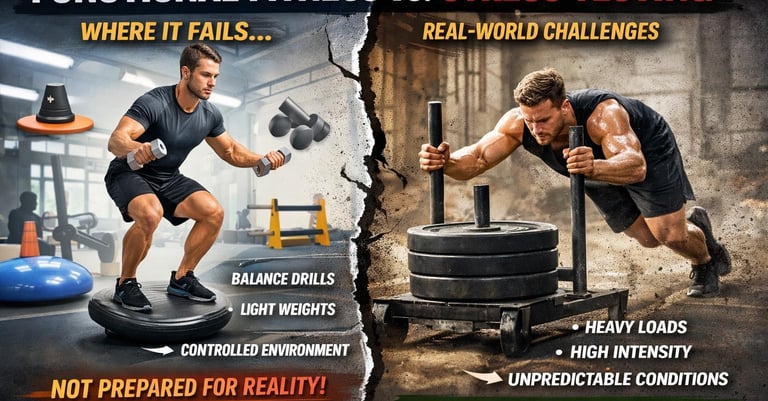
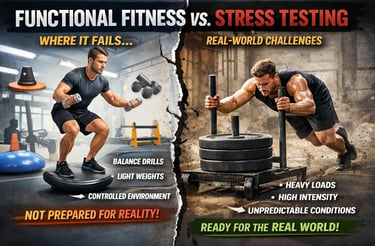
Lack of Real-World Application: Functional fitness tends to focus on controlled environments. The scenarios presented in a gym don’t always reflect the unpredictability of real-life challenges. For example, the strength required to lift an object off the ground can differ dramatically depending on its weight distribution or whether it’s moving. This lack of variability can lead to a false sense of security about one’s capabilities in unexpected situations.
Ignoring Mental Resilience: Physical strength alone isn’t sufficient for real-world survival. Mental resilience is crucial. Functional fitness often overlooks the psychological elements associated with physical challenges, such as managing fear during high-intensity performance or staying focused under pressure. In real crises, mental fortitude is as important as physical ability.
Inadequate Conditioning for High-Stakes Environments: Traditional functional fitness programs may not adequately prepare individuals for high-stakes environments where strength and stamina are tested to their limits. Situations like emergencies, natural disasters, or demanding physical tasks often require a blend of strength, endurance, agility, and quick reflexes that functional fitness doesn’t fully cultivate.
The Advantages of Stress-Test Training Enter stress-test training—an approach built on the idea of subjecting the body to realistic, challenging conditions to develop comprehensive survival strength. Stress-test training goes beyond the static environment of a gym and places the individual in varied, high-pressure situations that demand not only physical prowess but also strategic thinking and adaptability.
Simulating Real-Life Challenges: Stress-test training creates conditions that closely mimic the chaos of real-life scenarios. These can include obstacle courses, physical challenges under duress, or drills designed to push your limits in a controlled yet unpredictable manner. By doing so, the training prepares your body and mind to react instinctively during emergencies.
Enhancing Mental Toughness: When put under pressure, individuals learn to manage stress more effectively. Experiences foster resilience, allowing participants to develop a stronger sense of confidence and enhanced problem-solving abilities. Stress-test training involves pushing through discomfort, building grit, and cultivating a mindset that thrives in adversities—an invaluable asset in both fitness and life challenges.
Optimizing Functional Capacity: Unlike traditional functional fitness regimens, stress-test training enhances overall functional capacity by incorporating varied movements and physical tasks that require both strength and coordination. The incorporation of unpredictable challenges helps in fine-tuning agility, balance, and core strength—all essential components of survivable strength.
Community and Support: Stress-test training often takes place in group settings, fostering camaraderie and mutual support. Being surrounded by others who are equally invested in pushing through challenges can create a powerful and motivating environment. This communal ethos can lead to deeper connections that facilitate shared growth and resilience.
The Rise (and Problem) with Functional Fitness
The term "functional fitness" has gained tremendous traction within the fitness community, evolving from a niche appeal to a widespread movement embraced by gyms, trainers, and fitness influencers alike. But what exactly is functional fitness? Why has it become a buzzword, and what are the challenges associated with it? This Blog explores the phenomenon of functional fitness, distinguishing movement variety from performance readiness, and examining how the pressure to showcase impressive results on social media can distort the essence of fitness itself.
Why Functional Became a Buzzword Functional fitness revolves around training that prepares the body for real-life movements—activities we engage in daily such as squatting, bending, lifting, and twisting. Unlike traditional weightlifting, which often isolates muscle groups, functional fitness seeks to enhance overall physical performance by developing strength, endurance, balance, flexibility, and coordination in a holistic way. Its rise in popularity can be attributed to several factors. Firstly, many fitness enthusiasts are becoming increasingly aware of the limitations of conventional gym workouts that focus heavily on aesthetics rather than practical skills. As the demographic of gym-goers has broadened, so too have their motivations; people want to feel stronger and more capable in their everyday lives rather than solely working toward an athletic ideal. The growing interest in wellness and activity levels has spurred the development of functional workouts that promise better performance both at the gym and in daily life. Moreover, functional fitness has been endorsed by various high-profile athletes and celebrities, leveraging social media platforms to amplify its visibility. Viral videos showcasing innovative workouts and success stories have contributed to the hype, positioning functional fitness as not only effective but also engaging and entertaining. However, amidst the buzz lies a critical underpinning: the definition of functional fitness can vary widely among individuals and practitioners. What is deemed functional for one person may not apply universally; thus, the term has faced scrutiny regarding its actual effectiveness.
Difference Between Movement Variety and Performance Readiness One of the vital discussions surrounding functional fitness is the distinction between movement variety and performance readiness. Movement variety refers to the range of movements and exercises incorporated into a fitness program. It is common to see various modalities and styles—from kettlebell swings to battle ropes—that engage different muscles and movement patterns. Proponents argue that this variety keeps workouts fresh and helps prevent plateaus. On the other hand, performance readiness is about equipping individuals with the physical capabilities needed to engage in specific physical activities or sports effectively. Performance readiness focuses on how well an individual can execute movements, maintain endurance, and apply strength in scenarios akin to those experienced in real life. The challenge arises when fitness programs prioritize movement variety for the sake of engagement, potentially neglecting the foundational elements that underpin performance readiness. A focus on flashy exercises may not necessarily translate to improved function or readiness for real-life tasks. Instead, it can lead to a discord where individuals may become adept at performing complex exercises but struggle with simpler, functional movements that are more applicable to daily living.
*Coach Notes- functional fitness collapses under real-world stress because it trains people for tidy, predictable movement patterns instead of chaotic, uneven high-pressure situations. Look guys.... a person who can crush perfect box jumps and even my favorite kettlebell flows in the gym can still fail when they have to lift a a twisted 70-lbs object out of an awkward angle in the car trunk. Well coach I can deadlift 500lbs ---great -- I admire that. Now look at that statement and add carrying a child down slippery stairs during and emergency. Still don't see it... ok.... one more how bout stabilizing an fallen friend who is on the floor, injured, and needing to stand up. Those task demand asymmetry, bracing under fear, grip change, shifting loads, and problem solving under stress- conditions that polished gym circuits rarely replicate... Understand now?
My dear athletes all of you yes even the ones who don't believe they are athletes you are. I'll teach on that later. This is the most important reason you should look forward to going outside to train or changing dynamic patterns. This is why Coach Yells Yells yellls!
How Most Programs Remove Stress to Look Impressive on Social Media As social media continues to shape the fitness culture, there is an undeniable pressure for fitness programs to yield visually impressive results. The instant gratification encapsulated by platforms like Instagram and TikTok often skews the reality of functional fitness. To compete for attention, many programs resort to high-intensity workouts or advanced movements that can be visually appealing but may not be grounded in genuine effectiveness. In their quest to look impressive, programs may inadvertently remove essential elements that contribute to a well-rounded fitness regimen. Training focuses often shift away from building endurance and skill mastery to aiming for jaw-dropping content. This often leads to less emphasis on form, safety considerations, and athletic proficiency and more priority on what “sells” on social media feeds. The result can be a cycle of superficial engagement that overlooks the deeper, more meaningful aspects of fitness. Additionally, the nature of social media can feed into an unhealthy mindset concerning fitness goals, where comparison becomes the norm. Aspiring fitness enthusiasts might feel compelled to mimic flashy tasks on their feed without assessing their individual capabilities or needs. The visual nature of social media may reinforce ideals that prioritize appearance over health and function, further complicating the overall conversation around meaningful fitness.
We can Surmise that:The rise of functional fitness reflects not only a shifting paradigm within the fitness landscape but also a nuanced dialogue about how we define effectiveness and capability in our training regimens. While movement variety is essential to maintain engagement, recognizing the importance of performance readiness is vital for those seeking to transform their health and skills sustainably. Moreover, as social media continues to influence how fitness is marketed and perceived, it’s crucial that we remember the fundamental purpose behind functional fitness—to empower people to move better, feel more capable, and enhance their overall quality of life. In navigating the complexities of this trend, individuals and trainers alike must strive to prioritize genuine functional improvement over surface-level aesthetics, ensuring that the functional fitness movement remains not just popular but profoundly impactful.
The Missing Element
Training Without Consequences In the quest for optimal physical performance and health, the importance of accountability in training cannot be overstated. The phrase "training without consequences" often refers to the absence of meaningful metrics or outcomes that are crucial for gauging the effectiveness of a training regimen. In this exploration, we will dissect how a lack of standards leads to diminished accountability, why certain training practices render effort ineffective, and how comfort can often masquerade as beneficial mobility or longevity.
No Standards = No Accountability In any field, accountability hinges on clearly defined standards. In the world of fitness training, these standards provide a framework within which progress can be measured and evaluated. When training lacks established benchmarks—such as specific performance metrics, benchmarks for strength, or guidelines for endurance—there’s a significant risk of complacency. Without standards, individuals can easily fall into the trap of assigning arbitrary meanings to their efforts. For example, one might feel content with doing a certain number of push-ups each day without realizing that this number doesn’t significantly push their physical limits. In this environment, personal growth stagnates because there’s no mechanism to motivate improvement or even gauge what improvement looks like. Accountability encourages individuals to confront their limitations and strive for progress. In contrast, when there are no standards by which to assess performance, it becomes all too easy to remain comfortable in a state of mediocrity. Moreover, a lack of accountability perpetuates myths within the fitness community, where individuals may blindly accept that they are making progress without measurable outcomes to support their claims.
Why Reps Without Time, Load, or Fatigue Mean Nothing The effectiveness of any training session is often categorized by three primary factors: time, load, and fatigue. When these elements are absent from a training program, the reps performed during workouts largely become irrelevant. - Time: Training without a defined duration can detract from the quality of workouts. The body requires specific time commitments to adapt and evolve physically. Short bursts of activity might produce energy boosts or momentary strength increases but lack the sustained challenge needed for long-term adaptations. - Load: The term 'load' refers to the weight or resistance applied during an exercise. Without proper load, the body often cannot reach its potential. It’s not merely about performing more repetitions but about challenging the muscle fibers adequately. If individuals perform endless reps with minimal resistance, they will likely maintain their current state rather than achieve the strength or endurance improvements they desire. - Fatigue: Fatigue serves as a critical indicator of whether a workout is effective. Effective training should be pushing the body to the point of temporary fatigue, signaling that the muscles are being adequately challenged. If a person leaves the gym feeling as fresh as when they entered, it’s a strong indication that they haven’t engaged meaningfully with their training program. Reps without adequate consideration for these factors are akin to clocking in hours at a job without accomplishing any tangible work. They provide a false sense of accomplishment while failing to yield any real benefits.
Comfort Disguised as Mobility and Longevity In recent years, the concepts of mobility and longevity have gained substantial traction within fitness circles. However, it’s essential to distinguish between true mobility practices and a form of exercise that merely promotes comfort. Many practitioners erroneously equate comfort with appropriate movement patterns or flexibility. While stretches and gentle movements can feel good in the moment, they do not necessarily foster true mobility—defined as a dynamic, functional range of motion over a joint that enables strength during loaded movements. True mobility challenges the body, enhancing both its strength and flexibility in a way that supports various physical activities and prevents injury. Longevity in fitness often emphasizes the importance of maintaining an active lifestyle well into one’s later years. However, without the challenge of moderate to intense training, individuals may experience a decline in their physical capabilities, leading to reduced quality of life as they age. Thus, practices that emphasize comfort without genuine challenges or progression often fall short of promoting real mobility or longevity. This is a critical area where awareness is necessary; individuals can unwittingly substitute superficial comfort in their exercise routines, which might feel self-care-centric but ultimately undermine their long-term fitness goals.
Understanding the Pr3detor Principle
The Relationship Between Failure and Preparation In the world of fitness and performance, the Pr3detor Principle emerges as a crucial insight: "If it can’t fail, it can’t prepare you." This philosophical underpinning drives a deeper understanding of how we train, emphasizing the need for stress tests that challenge not only our physical capabilities but also our mental toughness. To truly prepare for the unpredictable nature of life, training must incorporate elements of chaos, transition, and fatigue.
Stress Test Training
What It Really Means Stress test training transcends the conventional workout routine. It incorporates a variety of elements that simulate real-life challenges, pushing the boundaries of our physical and mental endurance. Let's delve into some core components that define effective stress test training: 1. Training Under Fatigue: Maximizing performance under fatigue is paramount. This means engaging in workouts designed to mimic conditions where your body is already tired, forcing you to adapt and push through discomfort. 2. Breathlessness and Transitions: Incorporating breathlessness as a training variable prepares the body for scenarios where maintaining control and composure becomes critical. Understanding how to manage breathing under stress is essential in any high-pressure situation. 3. Introducing Chaos: Real-world situations often involve unpredictable challenges. By using uneven loads, unconventional carries, and rapid transitions in training, athletes can better prepare for the uncertainties they will face. 4. Mental Degradation Under Physical Pressure: As physical strain increases, our mental acuity tends to wane. Training that acknowledges this degradation helps individuals hone their capacity to make sound decisions even when physically compromised.
*Coaches Notes- Special forces has an attrition rate of 77%+ percent why certain humans are better than others. NOOOOO!!!! It is a mental challenge it is a stress test innovatively disguised as physical challenges. But in reality the mental is what has to survive the body just follows! Same for fitness the mind survives the body adapts under what? PRESSURE!
Discovering Strength in Compromise Max Lifts vs. Usable Strength
Max lifts, while impressive, often don’t translate effectively when an athlete is under the stress of exhaustion. For this reason, testing max lifts should occur only a couple of times a year, allowing for a focused approach to development while prioritizing functional strength. We focus on maximal lifts 2 x per year on target with our Old Soviet style training principles. The difference between gym strength and usable strength becomes evident under duress. Usable strength is what carries over to real-life applications and situations where the conditions are far from ideal.
Pr3detor Training: Prioritizing Control in Chaos In Pr3detor training, the focus is on maintaining control in adverse conditions—essentially training yourself to perform at your best when you feel your worst. This approach fosters resilience and adaptability, equipping you not only to withstand challenges but also to thrive within them.
Why Kettlebells Dominate Stress-Test Systems Kettlebells are particularly effective in stress-test training for several reasons: 1. Offset Loads: The design of kettlebells allows for unique offsets that challenge stability and grip strength, essential components of overall fitness. 2. Grip Endurance as a Nervous System Training Tool: Utilizing kettlebells improves grip endurance, affecting the nervous system and enhancing overall strength and responsiveness during complex movements. 3. Carries, Complexes, and Flows: Kettlebell workouts incorporating carries, complexes, and movement flows simulate the multi-dimensional nature of real life, serving as an effective pressure test during training sessions.
The Overlooked Mental Component Often overlooked in fitness discussions, the mental component of training is equally as crucial to success. Here’s how: 1. Decision Making Under Fatigue: Training within a context where decision-making is impaired by fatigue helps athletes develop essential problem-solving skills under pressure. 2. Emotional Regulation While Under Load: Understanding how to manage your emotions during heavy lifts or stressful workout conditions allows for greater performance and helps to build mental toughness. 3. Earning Confidence Through Exposure: True confidence comes from exposure to pressure, not merely through positive affirmations. Each encounter with challenges builds a reservoir of experience that enhances performance during actual high-stakes situations.
The Pr3detor Hook: Embrace the Pain and Adapt Upon digesting this holistic view of training, the Pr3detor hook comes into play: "If your training can’t survive chaos, it’s not functional; it’s decorative!" This pivotal statement encourages athletes to evaluate their fitness routines critically, ensuring they are grounded in reality and capable of withstanding the unpredictable twists and turns of life.
Conclusion The rise of functional fitness reflects not only a shifting paradigm within the fitness landscape but also a nuanced dialogue about how we define effectiveness and capability in our training regimens. While movement variety is essential to maintain engagement, recognizing the importance of performance readiness is vital for those seeking to transform their health and skills sustainably. Moreover, as social media continues to influence how fitness is marketed and perceived, it’s crucial that we remember the fundamental purpose behind functional fitness—to empower people to move better, feel more capable, and enhance their overall quality of life. In navigating the complexities of this trend, individuals and trainers alike must strive to prioritize genuine functional improvement over surface-level aesthetics, ensuring that the functional fitness movement remains not just popular but profoundly impactful. Incorporating the tenets of the Pr3detor Principle into your training regimen will cultivate not just a strong body but a resilient mind. Embrace the discomfort, train through chaos, and prepare yourself for whatever challenges lie ahead. A commitment to functional training—where failure and struggle become a stepping stone rather than a setback—will ultimately yield profound rewards both inside and outside the gym.
PR3DETOR
Tribe-Driven. Archetype-Based. Challenge-Built.
Privacy Policy
(C) 2026 Pr3detor. All rights reserved.
Support: Support@pr3detor.com Built for the Tribe.
LEGAL
About Us