
The Power of a 10% Gain: Understanding the Impact in Powerlifting
"Goal 10%"
Coach Gabe
2/24/20268 min read


Introduction to Powerlifting Gains
Powerlifting is a strength sport that focuses on three primary lifts: the squat, bench press, and deadlift. These lifts are designed to assess an athlete's maximal strength, making powerlifting a competitive arena that emphasizes incremental performance improvements. Achieving gains in these lifts not only signifies enhanced physical capability but also reflects the athlete's commitment and training efficiency.
In the context of powerlifting, a 'gain' typically refers to an increase in the maximum weight an athlete can lift in these key movements. While the concept may seem straightforward, the journey towards achieving these gains is complex and requires a strategic approach encompassing training, nutrition, and recovery practices. Powerlifters often set specific goals, such as increasing their one-repetition maximum (1RM), which is the maximum weight they can lift in a single attempt for each lift.
Performance gains in powerlifting are measurable and quantifiable, with a significant focus on the metrics associated with squat, bench press, and deadlift. Notably, even a 10% gain in an athlete’s lift can represent a substantial leap in performance, leading to improved competitive standings and personal records. Athletes continually assess their progress through various metrics, allowing them to identify training regimens that optimize their strength development. This systematic evaluation plays a crucial role in understanding how even modest improvements contribute to overall athletic performance and success in the sport.
The Importance of a 10% Gain in Powerlifting
In the realm of powerlifting, achieving a 10% increase in one’s lifting capacity is a considerable milestone. This benchmark is not merely a number; it represents a significant transformation in both physical strength and mental fortitude for the lifter. For beginners, a 10% gain can serve as a motivational catalyst, reinforcing the notion that continuous progression is feasible and attainable. Such early gains build confidence, fostering a positive training environment that can lead to sustained commitment and further development.
For seasoned athletes, the significance of a 10% increase can be even more profound. In a discipline where margins of improvement tend to be incremental, gaining even a small percentage can create substantial advantages in competition. Enhanced lifting capacity may translate into overcoming previous personal records, securing higher rankings, and even entering elite competitions. This is particularly relevant in a sport where the competition often consists of athletes who already operate at the upper limits of their capabilities, making every bit of progress count.
When compared to gains in other athletic disciplines, powerlifting presents unique dynamics. In sports such as sprinting or swimming, performance improvements are often measured in fractions of seconds. Conversely, in powerlifting, a 10% gain directly reflects in increased weight lifted. This tangible aspect of progress highlights the weight-centric nature of powerlifting, making a 10% increase feel more influential and rewarding. Through this lens, it becomes evident that a gain of this magnitude is not just a numerical increment but a monumental achievement that shapes the lifter's journey.
Breaking Down the Numbers: How a 10% Gain is Calculated
In the world of powerlifting, monitoring progress is vital for both motivation and performance enhancement. One common milestone lifters strive for is achieving a 10% gain in their lifts. Calculating this percentage increase is straightforward and can significantly inform a lifter's training approach.
The formula to ascertain a 10% gain is simple: multiply the current maximum lift by 0.10, and then add that value to the original lift. For example, if a powerlifter has a squat max of 200 pounds, the calculation would be: 200 lbs x 0.10 = 20 lbs. Thus, a 10% gain would lead to a new target of 200 lbs + 20 lbs = 220 lbs.
Let's delve into some examples across various lifts. For a bench press with a current maximum of 150 pounds, the 10% gain calculation would be: 150 lbs x 0.10 = 15 lbs. The new goal then becomes 150 lbs + 15 lbs = 165 lbs. Similarly, for a deadlift max of 300 pounds, the calculation is: 300 lbs x 0.10 = 30 lbs, which brings the new target to 300 lbs + 30 lbs = 330 lbs.
These examples illustrate that a 10% gain can represent a substantial increase in weight lifted. This increment can significantly contribute towards achieving larger overall strength benchmarks over time. Lifters can apply this method to any training maximum they have, providing a clear framework for setting achievable lift targets based on their current performance. Establishing such quantifiable goals is essential for fostering growth in powerlifting, allowing athletes to track their progress effectively.
The Law of Accumulation in Powerlifting Numbers
The Law of Accumulation is foundational in the realm of powerlifting, highlighting the principle that small, consistent gains can result in substantial improvements over time. This concept operates on the premise that incremental strength gains—such as a mere 10% increase in lifting capacity—can lead to significant overall performance enhancements. In the context of powerlifting, this means that consistently striving for improvements, no matter how minor they may seem, can ultimately culminate in impressive achievements.
For instance, consider a powerlifter whose current squat max is 405 lbs. If this athlete consistently targets a 10% gain, their goal becomes an incremental increase of just 40.5 lbs. As the lifter progresses through their training cycles, they might achieve that goal over several months of focused effort and disciplined training. Each week might present opportunities to increase that squat by a little under 0.5-1.0 and more with microfracture weights. While these increments appear small on their own, they compound over time, leading to a 10% overall improvement that can be profoundly impactful. New Max 445.5!
Coaches Notes: A 10% increase is a full-system upgrade. Not just a number on a bar.
Neurological output- your CNS learns to fire harder, faster, better sequence
Tendon and connective tissue adaptation
Movement efficiency guys- this is leaking less force
The hormonal response -body learns, tolerates, and recovers from heavy loads
Identity stops lifting at a number and start lifting from a new number (Mindshift)
The Law of Accumulation underscores the importance of patience and consistency in training regimens. For example, lifters setting their eyes on a competition may focus on achieving small personal records in the weeks leading up to the event. By fixing their sights on attainable increases, such as enhancing their deadlift and bench press by a modest percentage, they continually build their overall capacity without risking injury or burnout. This method reinforces the idea that powerlifting success is not solely determined by leaps in strength but can largely be attributed to the combined effects of numerous incremental gains.
Psychological Effects of Achieving 10% Gains
Achieving a 10% gain in powerlifting is often seen as a significant milestone, both from a physical and psychological perspective. When powerlifters reach this target, they experience a profound boost in their confidence levels. This increase in self-assurance arises as they witness tangible progress in their performance, reaffirming their commitment to their training regimen. Such confidence not only enhances self-esteem, but also encourages lifters to set and strive for even more ambitious goals.
Furthermore, the psychological impact of a 10% gain extends to motivation, providing powerlifters with a renewed sense of purpose and determination. The journey toward achieving this goal often requires rigorous training, a focused mindset, and an adherence to proper nutrition. Once the objective is attained, it fosters a positive feedback loop that fuels further motivation. For many lifters, the prospect of hitting another milestone becomes an invigorating source of inspiration, transforming their workout experience into a more engaging and rewarding endeavor.
A 10% gain also plays a crucial role in enhancing goal-setting strategies for powerlifters. When lifters recognize that steady progress is attainable, they are encouraged to break their overarching objectives into smaller, more manageable targets. This incremental approach not only aids in maintaining focus but also reduces anxiety associated with aiming for larger gains. It becomes easier to track progress, and as each 10% increase is achieved, lifters can recalibrate their goals to align with their evolving capabilities.
In essence, the psychological effects of achieving a 10% gain go beyond mere numerical enhancements in lifting strength; they cultivate an empowering mindset that enriches the overall powerlifting experience. This sense of achievement exemplifies how mental fortitude is intricately intertwined with physical performance.
Training Strategies to Achieve a 10% Gain
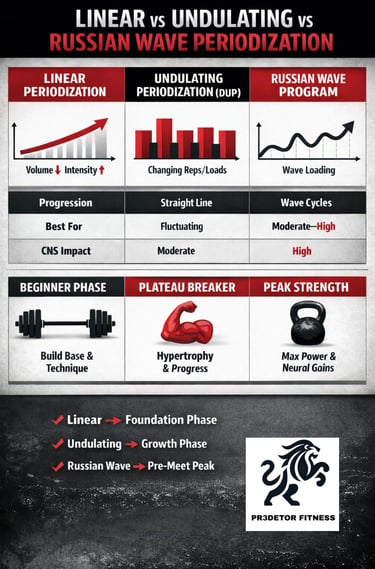
Achieving a 10% gain in powerlifting performance is a realistic goal that requires a multifaceted approach to training. One of the foundational components is effective programming. This involves structuring workouts to systematically challenge the body while allowing for adequate recovery. Programs such as linear and undulating periodization can be beneficial, as they prioritize variations in intensity and volume, targeting both strength and hypertrophy. This strategic cycling between heavy and lighter phases helps to build strength gradually and avoids plateaus.
Coaches Teach to Learn moment-
Linear Periodization (LP)- simple really ----- Start light--- get heavier every week--- peak!
Undulating Periodization (UP)- Change intensity and reps more often so the body never gets to comfortable.
Wave (Russian) My favorite- (RW)- 3 step volume phase (light more reps), Tension phase (moderate weights moderate reps), Intensity phase- heavier weight, low reps.
I don't understand it coach no worries I got you..........
Linear is a straight line climbing
Undulating changes intensity and frequency
Russian wave climbs, dips, climbs, dips-using controlled waves to sneak the CNS -Upward
Another crucial element for realizing a 10% increase in lifts is the implementation of recovery protocols. Proper recovery strategies include active recovery days, foam rolling, and stretching, which can help to mitigate muscle soreness and reduce recovery time between heavy lifting sessions. Adequate sleep is also essential, as it affects hormonal balance and muscle repair, ultimately impacting performance. Lifters should aim for 7-9 hours of quality sleep each night in addition to listening to their bodies and adjusting training loads based on how they feel.
Nutrition cannot be overlooked as a vital aspect of any training regime. A balanced diet that focuses on both macronutrient and micronutrient intake is essential for providing the energy needed for intense workouts and recovery. Lifters should focus on consuming sufficient protein to support muscle repair, complex carbohydrates for energy, and healthy fats for overall well-being. Hydration also plays a key role in performance, as even mild dehydration can impair strength output.
In summation, achieving a 10% gain in powerlifting is attainable through a well-rounded training methodology that incorporates targeted programming, recovery techniques, and sound nutrition. By implementing these strategies diligently, powerlifters can enhance their performance and work towards their strength goals effectively.
Conclusion and Future Considerations
In the realm of powerlifting, the concept of making incremental gains, often quantified as a 10% increase in performance, holds significant value. Understanding this idea is crucial for both novice and experienced lifters, as it highlights the importance of consistency and the cumulative effects of training. The law of accumulation suggests that small, consistent improvements can lead to substantial gains over time, underscoring the necessity for lifters to cultivate patience and dedication in their training regimens.
Moreover, setting realistic and achievable goals in powerlifting is instrumental for long-term progression. By focusing on gradual improvements rather than aiming for drastic changes, athletes can foster a mindset that embraces their journey in the sport. Establishing a structured plan that includes progressive overload, regular assessments, and adaptations based on performance, can greatly enhance overall effectiveness in training. This method encourages lifters to respect their individual limitations while pushing the boundaries of their capabilities.
As powerlifting evolves, future considerations should involve an integrated approach that incorporates proper nutrition, mental well-being, and recovery strategies alongside physical training. Understanding that performance improvements are not solely dictated by the weights lifted but also by holistic practices is essential. In nurturing this comprehensive view, lifters can maintain their motivation and longevity in the sport, paving the way for sustained improvement.
Ultimately, the real power of recognizing a 10% gain lies in its application to a lifetime of lifting. By embracing the journey and celebrating every small victory, powerlifters can continue to set new personal records, fostering a cycle of achievement that thrives on the principles of persistence and resilience.
Below is a visual representation of training strategies above.......
PR3DETOR
Tribe-Driven. Archetype-Based. Challenge-Built.
Privacy Policy
(C) 2026 Pr3detor. All rights reserved.
Support: Support@pr3detor.com Built for the Tribe.
LEGAL
About Us